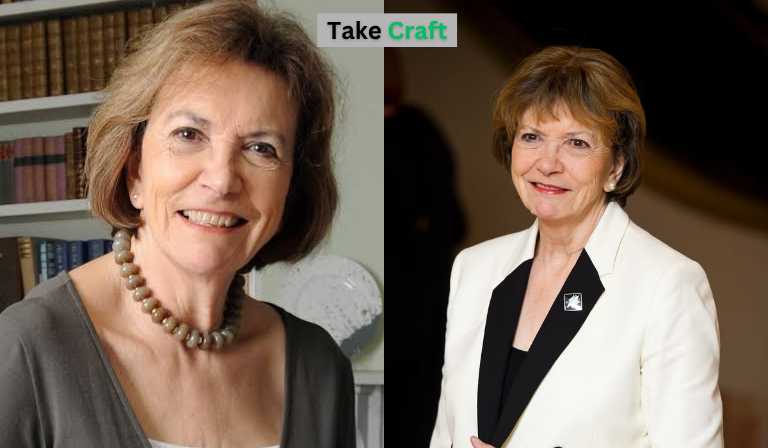
Joan Bakewell is one of the most respected and enduring figures in British broadcasting. Known for her intelligence, confident interviewing style, and willingness to discuss difficult social issues, she has built a remarkable career spanning television, radio, journalism, literature, and politics. Born in Stockport in 1933, she rose to national attention during the 1960s through BBC Two’s Late Night Line-Up and later became associated with major programs covering arts, ethics, culture, and society. Beyond broadcasting, she is an accomplished author and a Labour life peer in the House of Lords. Her personal life, including two marriages, two children, and her relationship with playwright Harold Pinter, has also attracted considerable public interest. This biography explores Joan Bakewell’s age, career, family, achievements, personality, and lasting influence on British media.
Joan Bakewell Quick Facts
| Fact | Details |
|---|---|
| Full Name | Joan Dawson Bakewell |
| Birth Name | Joan Dawson Rowlands |
| Date of Birth | April 16, 1933 |
| Age | 93 years old as of 2026 |
| Birthplace | Stockport, England |
| Nationality | British |
| Profession | Journalist, broadcaster, author, politician |
| Education | Newnham College, University of Cambridge |
| Political Affiliation | Labour Party |
| Known For | Late Night Line-Up, Heart of the Matter |
| Marital Status | Divorced |
| Former Husbands | Michael Bakewell, Jack Emery |
| Children | Two |
| Notable Relationship | Harold Pinter |
| Major Books | The Centre of the Bed, The Tick of Two Clocks |
| Political Title | Baroness Bakewell |
| Honour | Dame Commander of the Order of the British Empire |
Who Is Joan Bakewell?
Joan Bakewell is an English journalist, television and radio presenter, author, and member of the House of Lords. She became prominent during a period when television journalism was still largely dominated by men and went on to establish herself as a serious cultural commentator.
Her work has covered an unusually wide range of subjects, including art, religion, morality, relationships, social change, ageing, and death. Instead of limiting herself to entertainment broadcasting, she developed a reputation for thoughtful conversations about subjects that could be difficult or controversial.
Over several decades, Bakewell successfully moved between television, radio, newspaper writing, books, public speaking, and politics. That ability to remain relevant across different generations is a major reason she continues to be regarded as an important figure in British public life.
Early Life and Background
Joan Bakewell was born Joan Dawson Rowlands on April 16, 1933, in Stockport, England. She grew up in the Greater Manchester area and demonstrated strong academic ability from a young age.
She attended Stockport High School for Girls, where she eventually became head girl. Her education helped develop the confidence and intellectual curiosity that would later become central to her broadcasting style.
Bakewell continued her studies at Newnham College, Cambridge. She initially studied economics before changing to history. Cambridge exposed her to an intellectually stimulating environment at a time when British culture was beginning to undergo significant social change.
After university, her route into broadcasting was not immediate. She gained experience in several areas, including work connected with radio, teaching, and advertising, before gradually developing her television career.
Joan Bakewell Age and Physical Features
Born on April 16, 1933, Joan Bakewell is 93 years old as of 2026. Her long public career has made her a rare example of a broadcaster whose professional life has extended across several generations of British television.
During the 1960s, Bakewell received considerable attention for both her intelligence and appearance. Humorist Frank Muir famously described her as the “thinking man’s crumpet,” a phrase that became closely associated with her early public image.
The description reflected the attitudes toward female broadcasters at the time. Women appearing on serious television were often judged on their appearance in ways that their male colleagues were not.
Bakewell nevertheless proved that her career was based on far more than image. Her sharp interviewing skills, cultural knowledge, and ability to handle complicated subjects helped her remain relevant long after such early descriptions faded in importance.
Specific details such as her exact height and body measurements have not been reliably documented by authoritative public sources. It is therefore better to avoid unverified claims about her physical statistics.
Career and Major Achievements
The career of Joan Bakewell is closely connected with the development of modern British broadcasting. She first gained major attention through BBC Two’s Late Night Line-Up during the 1960s.
The program offered discussion and criticism of television, culture, and current issues. Bakewell stood out because of her confident interviewing style and ability to engage seriously with artists, writers, intellectuals, and public figures.
She later expanded her career into arts journalism and worked as an arts correspondent. This allowed her to explore literature, theatre, visual arts, television, and wider cultural developments.
One of her most important later programs was Heart of the Matter. The documentary series explored ethical and religious questions affecting ordinary people. Bakewell presented the program for around 12 years.
The show addressed subjects such as medical ethics, family relationships, faith, sexuality, and social responsibility. Her calm but probing presentation style made complicated moral debates accessible to a general audience.
In later years, she became familiar to a new generation of viewers through Sky Arts programs including Portrait Artist of the Year and Landscape Artist of the Year. These programs demonstrated her long-standing commitment to the arts.
Her achievements were also formally recognized. She received a CBE in 1999 and was appointed a Dame Commander of the Order of the British Empire in 2008.
In 2011, Joan Bakewell entered the House of Lords as a Labour life peer, becoming Baroness Bakewell of Stockport. Her political interests have included education, culture, media, ageing, and social policy.
She also served for many years as President of Birkbeck, University of London, further strengthening her association with education and lifelong learning.
Relationship with Harold Pinter
One of the most discussed parts of Joan Bakewell’s personal life was her relationship with playwright Harold Pinter.
Bakewell and Pinter had an affair during the 1960s while both were married to other people. Their relationship reportedly continued for approximately seven years.
The affair later became particularly significant because Pinter drew inspiration from it when writing his famous 1978 play Betrayal. The play explores an extramarital relationship and is notable for telling much of its story in reverse chronological order.
Bakewell later addressed the relationship from her own perspective. She wrote Keeping in Touch, a radio drama that offered a different interpretation of experiences connected with the affair.
Over time, she has spoken about that chapter of her life with unusual openness. Rather than allowing it to define her entire biography, she has treated it as one part of a much longer personal and professional story.
Marriage and Family Life
Joan Bakewell has been married twice. Her first husband was Michael Bakewell, a television and radio producer whom she met while she was a student at Cambridge.
They married in 1955 and had two children together. Their marriage lasted for approximately 17 years before ending in divorce.
Bakewell later married Jack Emery, a theatre producer. That marriage also eventually ended, and she has spent many of her later years living independently.
She has often discussed marriage, relationships, independence, and ageing in interviews and autobiographical writing. Rather than presenting her private life as perfect, she has written openly about the emotional complexity of relationships.
Her memoir The Centre of the Bed reflects on her marriages, love affairs, family life, work, and the experience of becoming independent after long-term relationships.
Does Joan Bakewell Have Children?
Yes, Joan Bakewell has two children, a daughter named Harriet and a son named Matthew. They were born during her marriage to Michael Bakewell.
Although Bakewell has discussed motherhood in relation to her wider life story, she has generally maintained a distinction between her public career and the private lives of her children.
Her experience of raising a family while developing a demanding broadcasting career also reflects the challenges faced by professional women during the middle decades of the twentieth century.
She managed to build a major television career during a period when social expectations around motherhood and women’s professional ambitions were very different from those of today.
Social Media Presence
Unlike many modern television personalities, Joan Bakewell built her reputation long before social media became a central part of celebrity culture.
Her public profile has traditionally been maintained through television appearances, radio programs, newspaper articles, books, interviews, speaking engagements, and parliamentary work.
She has therefore never depended heavily on platforms such as Instagram, TikTok, or YouTube to remain relevant.
Online discussions about her often focus on archive broadcasting clips, interviews, arts programs, political commentary, and her observations about ageing and British society.
Readers should be cautious with social media profiles using the names of established public figures, as not every account is necessarily official or personally managed.
Personality and Interests
Throughout her career, Joan Bakewell has developed a reputation for curiosity, independence, and intellectual confidence.
She appears particularly interested in how cultural changes affect ordinary people’s lives. This is reflected in her work on art, religion, morality, sexuality, relationships, ageing, and mortality.
Art has remained one of her strongest interests. From her years as an arts correspondent to presenting major television art competitions, she has consistently supported creative work and public engagement with culture.
Education has also been important to her. Her long involvement with Birkbeck reflected her belief in lifelong learning and the ability of people to continue developing intellectually at different stages of life.
Another important feature of her personality is her willingness to talk openly about ageing. Rather than attempting to hide the realities of becoming older, she has frequently discussed independence, health, housing, memory, death, and the practical decisions that accompany later life.
That openness has made her an important voice in conversations about how society views older people.
Net Worth and Income
There is considerable online interest in Joan Bakewell’s net worth, but no reliable public source has confirmed an exact figure.
Over her long career, she has earned income through television and radio broadcasting, journalism, writing, book royalties, public speaking, and other professional activities. She has also held significant public and academic positions.
However, estimates published on celebrity wealth websites should be treated carefully unless they are supported by financial records or statements from Bakewell herself.
As a result, assigning a specific multimillion-pound figure to her wealth would be speculative.
What can be said with confidence is that she has enjoyed an exceptionally long professional career across several fields. Her financial success is therefore likely connected to decades of broadcasting, publishing, journalism, and public work rather than a single source of income.
Public Image and Legacy
The legacy of Joan Bakewell extends far beyond one television program.
She entered British broadcasting when opportunities for women in serious journalism were far more limited than they are today. Despite frequently being discussed in terms of her appearance early in her career, she established herself as a thoughtful interviewer and cultural journalist.
Her longevity is particularly impressive. Broadcasting changed dramatically from the 1960s onward, yet Bakewell continued finding roles that suited new audiences and formats.
She also helped bring difficult subjects into mainstream conversation. Through programs dealing with religion, ethics, sexuality, ageing, death, and social change, she encouraged audiences to think about questions television once approached cautiously.
Her work as an author added another dimension to that legacy. Books such as The Centre of the Bed and The Tick of Two Clocks offered personal reflections on independence, relationships, possessions, ageing, and mortality.
Her entry into the House of Lords further expanded her public contribution. Instead of retiring from public life, she continued participating in discussions surrounding culture, education, older people, and society.
For many viewers, Joan Bakewell represents both the history of British television and its capacity to evolve.
Conclusion
Joan Bakewell has lived an extraordinary public life. From growing up in Stockport and studying at Cambridge to becoming a pioneering BBC broadcaster, acclaimed author, arts presenter, Dame, and member of the House of Lords, her biography covers some of the most important changes in modern British culture.
Her personal story has been equally complex. She experienced two marriages, raised two children, had a famous relationship with Harold Pinter, and later wrote openly about love, independence, ageing, and mortality.
At 93 in 2026, her importance is measured not simply by the length of her career but by what she contributed during it. She helped expand the role of women in broadcasting, brought challenging ethical and cultural issues into public discussion, and demonstrated that age does not have to end intellectual curiosity or public engagement.
Her place in British broadcasting history appears secure, making her life and career a fascinating subject for both longtime viewers and younger generations discovering her work.
FAQs About Joan Bakewell
1. How old is Joan Bakewell?
Joan Bakewell was born on April 16, 1933. She is 93 years old as of 2026.
2. What is Joan Bakewell famous for?
She is best known as a British journalist, broadcaster, author, and television presenter. Major programs associated with her include Late Night Line-Up, Heart of the Matter, and Sky Arts’ artist competition programs.
3. Who was Joan Bakewell’s husband?
She has been married twice. Her first husband was television and radio producer Michael Bakewell, and her second husband was theatre producer Jack Emery.
4. Does Joan Bakewell have children?
Yes. She has two children, Harriet and Matthew, from her marriage to Michael Bakewell.
5. Did Joan Bakewell have a relationship with Harold Pinter?
Yes. She had a long-term affair with playwright Harold Pinter during the 1960s. Their relationship later influenced Pinter’s play Betrayal.
6. Is Joan Bakewell a member of the House of Lords?
Yes. She became a Labour life peer in 2011 and holds the title Baroness Bakewell of Stockport.
7. What books has Joan Bakewell written?
Her works include the autobiography The Centre of the Bed and The Tick of Two Clocks, which explores ageing, downsizing, memory, and moving into a new stage of life.
8. What is Joan Bakewell’s net worth?
Her exact net worth has not been reliably confirmed. She has earned income from broadcasting, journalism, writing, books, public speaking, and other professional activities during her long career.