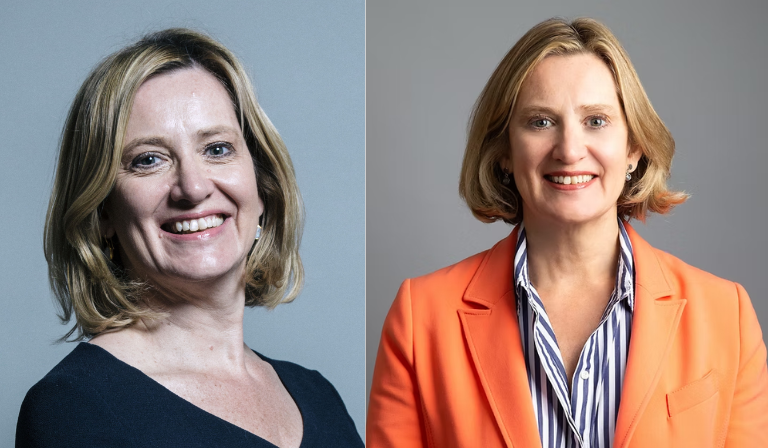
When you think of the turbulent political landscape of the United Kingdom in the late 2010s, few names capture the chaos, the ruthlessness, and the unexpected resilience quite like the name Amber Rudd. She was the face of “Hostile Environment” policies, the survivor of the Windrush scandal, the moderate voice in a Conservative party torn apart by Brexit, and eventually, a high-flyer who jumped before she was pushed. But her story doesn’t end on the backbenches of Parliament. In fact, many would argue that the second act of her career is proving to be far more serene—and lucrative—than the first.
For those who only caught the headlines, Amber Rudd was the Home Secretary who resigned. For political junkies, she was the ultimate “professional woman” of the Tory party—polished, sharp, and unafraid to take on the civil service. And today, she is a study in how modern politicians leverage their experience for corporate power. This article dives deep into her biography, her defining moments in office, her dramatic exits, and what she is doing now. Whether you are a student of politics, a history buff, or just curious about the figures who shaped the Brexit era, this is the full story of Amber Rudd.
The Making of a Politician: Early Life and Career
Before she was sitting in the Cabinet, Amber Rudd was navigating the very different world of finance and journalism. Born in 1963 into a privileged family in London, she attended Cheltenham Ladies’ College before heading north to the University of Edinburgh. It is a common observation that her background is quintessentially “Claridges and Chablis”—a sharp contrast to some of her rougher-edged colleagues in the Brexit debate. Yet, she never tried to hide her posh upbringing; instead, she weaponized it as competence.
After graduating with a history degree, she didn’t immediately run for office. Instead, she dove headfirst into the City of London. She worked in investment banking and venture capital, a period that gave her a thick skin and a deep understanding of balance sheets. Later, she moved into a distinctly different field: journalism. She wrote for financial publications and even set up a freelance recruitment business. This blend of finance, writing, and entrepreneurship is rare in Westminster, which is often dominated by career politicians who have never had a job outside of a constituency office.
Her entry into politics was a slow burn. She wasn’t a teenage activist; she came to the Conservative party as an adult who had seen the real world. She stood for Parliament unsuccessfully in 2005, but she persisted. In 2010, she finally broke through, winning the seat of Hastings and Rye. At the time, it was a marginal seat, meaning she had to work hard to keep it—a factor that kept her grounded even as she rose to national prominence. She was 47 years old when she entered the Commons, bringing a maturity that many of her younger colleagues lacked.
The Rise to the Cabinet: Energy and Climate Change
Unlike some who languish on the backbenches for decades, Amber Rudd moved quickly. David Cameron’s coalition government provided the first rung of the ladder. After a brief stint as a Parliamentary Private Secretary and a whip (roles essentially about keeping party members in line), she got her big break in 2014. She was appointed Parliamentary Under Secretary of State at the Department of Energy and Climate Change (DECC).
This was a fascinating role for her. She wasn’t a “green” activist, but she was a pragmatist. When the Conservatives won a surprise majority in 2015, she was promoted to Secretary of State for Energy and Climate Change. It was here that she began to earn a reputation for being unexpectedly robust. She stood at the despatch box defending onshore wind farm subsidies and nuclear power. She engaged with the global community at the COP21 summit in Paris, pushing for ambitious targets.
Yet, the seeds of her future conflicts were also sown here. She inherited a department that was skeptical of her lack of scientific background, but she mastered the brief quickly. She famously clashed with the then-Chancellor George Osborne over cuts to solar power subsidies, showing that she was not afraid to fight the Treasury for her department. It was a display of backbone that impressed many observers, setting her up for a bigger prize down the line. She was a rising star, seen as a safe pair of hands who could handle complex technical briefs without losing her cool.
The Home Office Years: A Storm Brewing
In July 2016, the political landscape of the UK detonated. The Brexit referendum result led to the resignation of David Cameron, the swift ascendancy of Theresa May, and a dramatic reshuffle. Amber Rudd was plucked from the quiet world of energy policy and thrown into the bear pit of the Home Office. This was a major promotion. Historically, the Home Office is where political careers go to die. It is the department of immigration, security, and policing—three areas where things are constantly going wrong.
Theresa May trusted her. They were both “modernizing” Conservatives, generally pro-remain (though Rudd voted remain, she accepted the result), and both were women who had faced the “nasty party” label of the old Tory boys’ club. For a while, things ran smoothly. She dealt with the aftermath of terror attacks in London and Manchester with a somber dignity. She pushed for greater internet regulation and increased police funding. On the surface, she looked like a Home Secretary in control.
But beneath the surface, a catastrophic policy failure was brewing: the Windrush scandal. The “Hostile Environment” policy, designed to make life so difficult for illegal immigrants that they would self-deport, had been turned on legal residents. People who had arrived from the Caribbean as children in the 1950s—the “Windrush generation”—were being denied healthcare, losing their jobs, and even being detained and deported because they couldn’t prove their legal status. They had lived in the UK for fifty years, but because they arrived on their parents’ passports, they had no paperwork. The scandal was a moral horror show.
The Resignation and Windrush Fallout
The pressure on Amber Rudd intensified throughout early 2018. She was forced to apologize repeatedly in Parliament. However, the fatal blow came from a specific lie—or, as she called it, an “inadvertent misleading.” When asked by a select committee if the Home Office had targets for removing illegal immigrants, she said no. Documents later emerged showing there were, in fact, “local targets” for voluntary returns.
She was caught in a classic political trap. She claimed she had been misled by her own officials. An inquiry later found that she was “let down” by the civil service, which had fed her incorrect information and failed to correct the record. She also accused officials of “high-level” leaks designed to embarrass her. In a dramatic confession, she admitted that she lost so much faith in her own department that she began preparing for parliamentary appearances alone, a decision a subsequent report called “dangerous”.
On April 29, 2018, she resigned. It was a late-night resignation, the kind that signifies a total meltdown. She wrote to Theresa May expressing deep regret for misleading Parliament, even if unintentional. For many, she was the scapegoat for a culture of callousness that had been fostered by Downing Street for years. For others, she was the architect of her own downfall, a minister who didn’t know what her department was doing. The resignation shook the government, leaving it vulnerable and exposing the chaos behind the scenes. In the reshuffle that followed, she was replaced by Sajid Javid, who immediately tried to detoxify the “Hostile Environment” rhetoric.
The Lazarus Act: Return to Work and Pensions
Most politicians who resign in disgrace disappear into the wilderness, spending years trying to rehabilitate their reputation. Amber Rudd did not have the patience for that. She was back in government within seven months.
In November 2018, following the resignation of Esther McVey over the Brexit withdrawal agreement, Theresa May brought Rudd back as Secretary of State for Work and Pensions. It was a bold move. The Department for Work and Pensions (DWP) was responsible for Universal Credit and welfare sanctions—a portfolio just as controversial as immigration. She was now in charge of the benefits system, tasked with making it more humane while cutting costs.
Her return was met with mixed emotions. However, she immediately began to pivot. She admitted that the sanctions regime was too harsh. She announced that “in the future, the longest length of a sanction will be six months,” attempting to soften the sharp edges of austerity. She also took on the role of Minister for Women and Equalities. It seemed like she had learned from the Windrush disaster. She was less dogmatic, more willing to listen to critics. She spoke openly about the need for the Conservative party to stop being “nasty” on welfare. It was a second chance, and for a while, she used it well.
The Final Act in Government: Brexit Sacrifice
The return to glory, however, was short-lived because the ground had shifted. Theresa May resigned, and Boris Johnson—a man whose politics Rudd found deeply unsettling—became Prime Minister. Johnson offered her a lifeline, keeping her on as DWP Secretary because he needed “moderates” to balance his cabinet of hardliners. But the marriage of convenience was doomed.
The breaking point came with Brexit. Boris Johnson was committed to leaving the EU by October 31st, with or without a deal (the “No Deal” scenario). Amber Rudd was horrified by “No Deal,” viewing it as an act of economic vandalism. The final straw was Johnson’s decision to expel 21 moderate Conservative MPs from the party for voting against the government to block a No Deal Brexit. These were her friends, her allies. She couldn’t stomach it.
On September 7, 2019, she walked. She resigned from the Cabinet and, crucially, surrendered the Conservative whip. In her resignation letter, she didn’t hold back. She accused the government of sabotaging its own negotiations. “I cannot stand by as good, loyal moderate Conservatives are expelled,” she wrote. For a few weeks, she sat as an Independent MP. She did not contest the 2019 general election, drawing a definitive line under her political career. She had lost her seat by proxy, choosing principle over power—or at least, that is how history will likely remember her exit.
Life After Politics: The Corporate Reinvention
So, where is Amber Rudd now? If you thought she retired to a cottage in the country to knit, you would be wrong. She has done what many former ministers do: she cashed in her chips and moved to the boardroom. But unlike some who simply take sinecures, she has focused her portfolio on where her expertise lies.
Currently, she sits on the board of some very heavy-hitting companies. She is an Independent Non-Executive Director at Centrica Plc, the parent company of British Gas. This is a perfect fit, given her history as Energy Secretary. She knows the regulation, the infrastructure, and the political risks. She also joined the board of Ryanair Holdings Plc as a Non-Executive Director in 2024. This raised a few eyebrows given Ryanair’s labor disputes, but her role is to provide governance and strategic oversight. She also works with Pinwheel Ltd. and acts as a Strategic Adviser for New Energy One Acquisition Corp.
Her net worth is estimated to be in the region of $118,000 in disclosed holdings, though this likely does not account for her full private wealth. Beyond the private sector, she stays involved in public life. She is a Trustee of the Royal United Services Institute (RUSI), a premier defense and security think tank. She also co-hosts a podcast called “The Crisis Room,” reviewing foreign policy issues. She has moved from being the story to analyzing the story, a transition that suits her polished media skills perfectly.
The Legacy of a Modern Tory
Assessing the legacy of Amber Rudd is tricky because she represents the “almost.” Was she almost the first female Chancellor? No. Was she almost the next leader of the Tory party? Almost. In May 2026, reports surfaced that she ruled herself out of a bid for the top job, saying, “I don’t think it’s my time at the moment,” effectively acknowledging that the party had moved further right than her comfort zone.
She is the embodiment of the “One Nation” Conservative that has gone extinct in the current parliament. She believed in free markets, social justice (to a degree), and international cooperation. In the era of Johnson, Truss, and Sunak, that brand of politics looked old-fashioned. Yet, for many voters, she was the kind of Tory they wished still existed: competent, moderate, and female.
Her time at the Home Office will forever be stained by Windrush. No amount of corporate success can wipe that clean. But her final act of defiance against Boris Johnson gave her a graceful exit. She proved she wasn’t just a careerist; she had red lines. In the brutal world of Westminster, where loyalty is often a one-way street, Amber Rudd managed to walk out with her integrity (mostly) intact—a rare feat indeed.
Frequently Asked Questions
Why did Amber Rudd resign as Home Secretary?
Amber Rudd resigned as Home Secretary in April 2018 due to the Windrush scandal. She admitted to “inadvertently misleading” Parliament when she claimed the Home Office did not have targets for the removal of illegal immigrants. Documents later revealed local removal targets existed. Although an inquiry found she was let down by officials who gave her bad information, she took responsibility and stepped down.
What is Amber Rudd doing now?
Currently, Amber Rudd works primarily in the private sector. She serves as a Non-Executive Director for Centrica (British Gas) and Ryanair Holdings. She is also a trustee for the Royal United Services Institute (RUSI) and co-hosts a foreign policy podcast called “The Crisis Room”. She has largely stepped away from frontline politics.
Did Amber Rudd support Brexit?
Amber Rudd was a vocal supporter of the “Remain” camp during the 2016 referendum. However, after the vote, she accepted the result and worked to try to secure a deal with the European Union. She resigned from Boris Johnson’s government in 2019 specifically to protest his push for a “No Deal” Brexit, which she viewed as dangerous for the economy.
What is Amber Rudd’s net worth?
While exact figures vary, public records estimate Amber Rudd‘s net worth in liquid assets held in public companies to be around $118,000 to $120,000. This figure represents only her disclosed shareholdings (such as in Centrica) and does not include her earnings from private advisory work, board fees, or her previous ministerial salary.
Which constituency did Amber Rudd represent?
Amber Rudd was the Member of Parliament (MP) for Hastings and Rye. She held the seat from 2010 until she stepped down in 2019. It was historically a marginal seat, but she managed to build a strong personal brand there, attending local events such as bursary ceremonies for students.
Conclusion
From the high-stakes trading floors of the City to the high-pressure corridors of the Home Office, Amber Rudd has led a fascinating life. She is a figure of contradictions: a privileged socialite who became a workhorse MP; a Home Secretary who lost control of her department; a loyal minister who eventually rebelled against her party. As the Conservative party continues to evolve, figures like Amber Rudd serve as a reminder of a previous era—one that valued technocratic competence over populist shouting. She survived the fire of Westminster and emerged not as a prime minister, but as a successful corporate director and podcaster. And in the long run, that might just be the quietest form of winning.