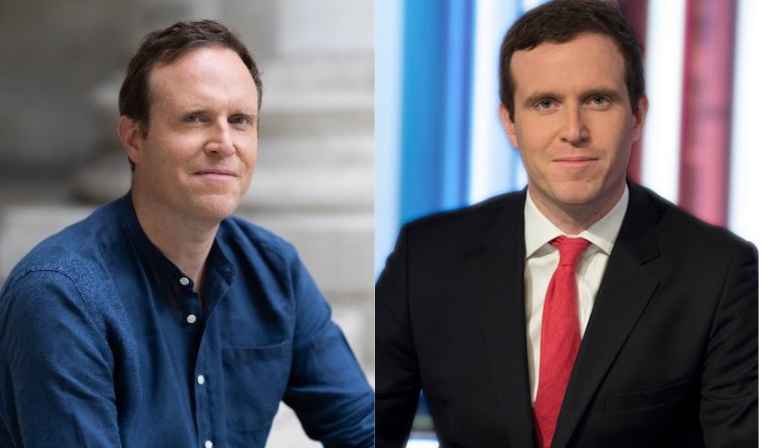
If you have ever found yourself staring at a smartphone screen, wondering how on earth a piece of glass and metal can connect you to the entire planet, you have probably been thinking like Ed Conway. He is the kind of journalist who doesn’t just look at the stock market ticker; he looks at the physical stuff underneath it. As the Economics and Data Editor for Sky News, Conway has built a reputation for breaking down the most complex financial crises into stories that actually make sense to regular people. But more recently, he has gone viral for a different reason: his obsession with sand, salt, and lithium.
Conway isn’t your typical economist hiding in an ivory tower. He is known for wandering through the deepest mines in Europe or standing next to a towering blast furnace to explain why the green transition is way harder than politicians let on. His journey from a Fulbright scholar at Harvard to one of the UK’s most trusted broadcasters is a masterclass in curiosity-driven journalism. Whether he is interviewing Chancellors of the Exchequer or digging into the science of copper wiring, Ed Conway has a unique ability to connect the dots between the money in your wallet and the ground beneath your feet.
This article dives deep into the life, career, and intellectual impact of Ed Conway. We will look at his early days at The Daily Telegraph, his pivotal move to Sky News, and his celebrated books, including Material World, which was shortlisted for the Financial Times Business Book of the Year Award. If you want to understand how modern economics actually works—not how it should work in a textbook—you have come to the right place.
The Education of a Modern Broadcaster
Before Ed Conway was analyzing the fiscal policy of the British government, he was soaking up a very different kind of education. He was born Edmund Conway and attended The Oratory School, a Roman Catholic boarding school in Oxfordshire. It was a solid start, but the real intellectual heavy lifting happened at Oxford University. He attended Pembroke College, Oxford, where he earned a Master of Arts. Interestingly, his degree wasn’t in Economics. He studied English. That might sound counterintuitive for someone who edits economics news, but it actually explains a lot about his writing style. He approaches graphs and GDP figures like a storyteller, looking for the narrative arc in the data rather than just the dry numbers.
After Oxford, Conway didn’t stop. He worked for several years as a journalist before earning a prestigious Fulbright Scholarship. This scholarship took him to the United States to attend the John F. Kennedy School of Government at Harvard University. There, he earned a Master’s in Public Administration. This blend of humanities and high-level policy gave him a rare edge. He understands the numbers, sure, but he also understands the people behind the numbers. He once noted that the best economists aren’t the ones who can solve complex algorithms fastest; they are the ones who can explain why interest rates affect a family’s dinner table. That human-first approach is the secret sauce of his entire career.
Breaking News at The Daily Telegraph and Daily Mail
Before the glitz of television, Ed Conway cut his teeth in the rough-and-tumble world of print journalism. He started as an economics correspondent for the Daily Mail, learning how to turn Bank of England press releases into front-page news. But it was his tenure at The Daily Telegraph and The Sunday Telegraph that really put him on the map. He rose to become the Economics Editor for these publications, a role that saw him navigating the treacherous waters of the 2008 global financial crisis.
It was during his time at the Telegraph that Conway really started to make waves. He was one of the first journalists to warn the public about the “funding gap” in the banking system. For most people, this term sounds like jargon, but Conway explained it in a way that made the average person realize that the cash machine might stop working. This reporting didn’t just earn him accolades; it proved to be prophetic. It essentially foreshadowed the collapse of Northern Rock, an event that marked the beginning of the UK’s recession. He also broke exclusive stories regarding the Bank of England’s plans to create additional money through a process called quantitative easing. At the time, QE sounded like a weird academic experiment, but Conway told his readers exactly what was coming and why it mattered.
The Move to Sky News and Television Stardom
In August 2011, British television gained a new voice. Ed Conway made the leap from the printed page to the 24-hour news cycle, joining Sky News as their first-ever Economics Editor. This was a big deal. While broadcast news often prioritizes the “talking head” who shouts the loudest, Sky News was betting on depth and accuracy. Conway didn’t just read an autocue; he brought a laptop and a whiteboard.
At Sky News, Ed Conway became a familiar face during every major economic tremor. He covered the euro crisis when Greece was teetering on the brink of default, the G20 summits where world leaders bickered over bailouts, and the ongoing ripple effects of the Great Recession. One of his most valuable skills is his ability to interview the heavyweights. He has sat down across from Christine Lagarde (the Managing Director of the IMF), Philip Hammond (the Chancellor of the Exchequer), and Mark Carney (the Governor of the Bank of England). He doesn’t throw softballs, but he also avoids the “gotcha” style of journalism. He asks the question that the viewer at home is thinking: “But wait, where does the money actually come from?”.
As of recent years, his title has evolved to Economics and Data Editor. In an age of “fake news” and misinformation, Ed Conway leans hard into the data. He uses Sky News’ platforms to show the public the charts and the evidence, making him one of the longest-running and most respected economics editors in UK journalism.
The Author: 50 Economics Ideas and The Summit
While his day job keeps him busy, Ed Conway has also built a parallel career as a successful author. He has a knack for taking huge, intimidating topics and shrinking them down into digestible bites. His first major book, 50 Economics Ideas You Really Need to Know, was published in 2009. It is exactly what it says on the tin. It takes complex theories like Keynesianism, monetarism, and the tragedy of the commons and explains them in short, sharp bursts. The book was a hit, becoming a bestseller and being translated into thirteen different languages, proving that people are hungry for smart, simple explanations of the financial world.
But he didn’t stop at the basics. In 2014, Conway published The Summit: The Biggest Battle of the Second World War – Fought Behind Closed Doors. This book shifted gears from pure economics to history, focusing on the Bretton Woods conference. This is the meeting in 1944 that essentially designed the global financial system we live in today. It’s a story about rival economists, world leaders, and the battle to rebuild capitalism after the war. It is less about a textbook and more about the high-stakes poker game that created the World Bank and the IMF. It cemented Conway’s reputation as a writer who could make policy exciting.
Material World: The Book That Changed Everything
If you ask anyone on social media about Ed Conway right now, they will likely mention Material World. Published in 2023, this book was a paradigm shift. While most economists are looking at services, digital currency, and the stock market, Conway looked down. He wrote about sand, salt, iron, copper, oil, and lithium. He argues that these six materials actually built civilization, and if we don’t understand them, we don’t understand the future.
The book became a Sunday Times Bestseller and was shortlisted for the prestigious Financial Times Business Book of the Year Award. It also snagged a spot on the shortlist for the British Academy Book Prize. Critics went wild for it. Peter Frankopan called it “lively, rich and exciting,” while Tim Marshall said it was “compelling”. In Material World, Ed Conway travels to the deepest mine in Europe, the silicon chip factories of Taiwan, and the lithium pools of South America. He reveals the hidden供应链 (supply chains) that we take for granted until a war or a pandemic breaks them.
The central thesis of Material World is vital for the climate change debate. Conway points out that while we want electric cars and wind turbines, we rarely talk about the mining required to build them. You can’t have a green future without digging up a lot more copper and lithium. He doesn’t say this to be a downer; he says it to be realistic. As he puts it, we live in a material world (pun intended), and pretending otherwise is a recipe for failure. The book has been longlisted for the Wainwright Conservation Writing Prize as well, highlighting its impact on how we view our relationship with the planet.
Quote from Material World: “They took us from the Dark Ages to the present day. They power our computers and phones, build our homes and offices, and create life-saving medicines. But most of us take these six crucial materials completely for granted.”
Recognition and Industry Influence
It is rare for a journalist to be embraced by the scientific and engineering communities, but Ed Conway has managed that feat. In late 2024, the Institute of Materials, Minerals and Mining (IOM3) announced that they had elected Ed Conway as an Honorary Fellow. This is a huge deal because it means the people who actually make the physical stuff—the engineers and metallurgists—recognize him as one of their own.
When accepting the honor, Conway admitted he came to the world of materials as an “outsider.” He felt intimidated at first. But his ability to listen, learn, and translate the complex science of mining into plain English earned him their respect. He now works closely with such institutions to bridge the gap between the general public and the often-hidden world of extraction and manufacturing. He has lectured on the international monetary system at the London School of Economics and even at the US Treasury, proving that his influence spans the Atlantic.
His digital presence is also significant. He has a massive following on X (formerly Twitter) under the handle @EdConwaySky. He uses the platform not just to promote his Sky News segments but to break down data visualizations and argue with followers about inflation figures. In an era where journalists are often accused of being out of touch, Ed Conway stays in the trenches of the comment section, defending data-driven analysis with patience and wit.
Analyzing the Modern Economy
So, what does Ed Conway think about the current state of things? If you watch him on Sky News, you will notice a few recurring themes. First, he is a realist about inflation. He avoids the alarmist panic that you see on some networks, but he also refuses to pretend that high prices aren’t hurting people. He digs into the core metrics, looking at service inflation versus goods inflation, explaining to viewers exactly why the Bank of England is raising rates (or not).
Second, he is obsessed with productivity. It sounds like a boring subject, but Conway makes it fascinating. He argues that the UK’s economic stagnation isn’t just about Brexit or COVID—it is about the fact that we aren’t making enough stuff efficiently. He points back to his book Material World, noting that for decades, we offshored our manufacturing and stopped valuing engineering. Now, we are facing the consequences of a skills shortage in exactly the industries we need to fight climate change.
He is also a sharp critic of groupthink. Whether he is interviewing a Labour shadow chancellor or a Conservative minister, Conway pushes back on easy answers. He asks, “How are you going to pay for it?” and “Where are the workers going to come from?” He holds a unique position in British media because he is trusted by both business leaders who watch Sky News for market updates and by younger activists who read his threads about lithium mining.
The Future According to Conway
Looking ahead, Ed Conway is focused squarely on the energy transition. He warns that the world is walking into a “resource trap.” We want electric vehicle batteries, but we don’t want mines in our backyard. We want to stop using fossil fuels, but we haven’t built the grid infrastructure to handle the load. He uses his platform to point out these uncomfortable truths.
He predicts that geopolitics will increasingly revolve around supply chains for critical minerals. The countries that control the refining of rare earth elements or the mining of cobalt will have the power in the 21st century, much like oil producers did in the 20th. He argues that Western nations have become naive, assuming that free trade would always provide what they needed. Now, they are scrambling to catch up. In his writing for The Times, where he is a regular columnist, he frequently argues for deregulation in mining and faster approval for infrastructure projects. He is a liberal in the classical sense—believing in markets, but also believing in the hard, physical reality of the planet.
Ed Conway is not just reporting on the economy; he is redefining what the economy is. It isn’t just flows of digital cash. It is the sand in the concrete, the salt on the roads, and the copper in the wires. By bringing this perspective to the mainstream, he has done the public a massive service. He has made us all look at the ground beneath our feet with a little more respect.
Key Data Snapshot: Ed Conway’s Career
Aspect Details Current Role Economics & Data Editor at Sky News Background Daily Mail, Daily/Sunday Telegraph Education Oxford (MA English), Harvard (MPA) Notable Book Material World (2023) Awards FT Business Book of the Year Shortlist, IOM3 Honorary Fellow Focus Macroeconomics, Supply Chains, Mining, Data Visualization
Conclusion
In a media landscape often defined by short attention spans and hot takes, Ed Conway stands out as a deep thinker. He moved from the back pages of The Daily Telegraph to the breaking news studio of Sky News without ever losing his intellectual integrity. He has the rare ability to talk to a Nobel Prize-winning economist in the morning and explain the same concept to a truck driver watching television in the afternoon, without dumbing it down for either.
His work, particularly Material World, has changed the conversation. No longer can we just talk about “services” and “digital transformation” without asking where the physical stuff comes from. He has forced a reckoning with the reality that we are a species living on a finite planet, and that our economic models need to catch up to that fact. Whether he is being honored by the IOM3 or breaking a story about a government bailout, Ed Conway remains one of the most vital voices in British journalism. He makes you smarter every time you listen, and in the noisy chaos of the 24-hour news cycle, that is the highest compliment you can pay.
Frequently Asked Questions
Who exactly is Ed Conway and what does he do?
Ed Conway is the Economics and Data Editor for Sky News in the UK. He is a journalist and author responsible for covering major financial events, interest rate decisions, and economic policies. He also writes columns for The Times and has written several bestselling books, including Material World and 50 Economics Ideas You Really Need to Know. He is known for breaking down complex economic concepts into easy-to-understand language for the general public.
What is Ed Conway’s educational background?
Ed Conway has a unique academic mix. He earned a Master of Arts in English from Pembroke College, Oxford. Later in his career, he won a Fulbright Scholarship to attend the John F. Kennedy School of Government at Harvard University, where he earned a Master’s in Public Administration. This combination of humanities and public policy gives him a distinctive storytelling approach to economics.
What is the main argument of the book Material World?
The main argument of Material World is that we cannot understand human history or our future without understanding six key materials: sand, salt, iron, copper, oil, and lithium. Ed Conway argues that modern society takes these resources for granted. He shows how the hidden supply chains for these materials are the real drivers of geopolitics and climate change, and that transitioning to green energy will require massive, realistic increases in mining and production.
Has Ed Conway won any awards for his journalism or writing?
Yes, Ed Conway has received significant recognition. He won the Wincott Foundation Journalist of the Year award. His book Material World was shortlisted for the Financial Times Business Book of the Year Award and the British Academy Book Prize. In 2024, he was elected an Honorary Fellow of the Institute of Materials, Minerals and Mining (IOM3) for his contribution to the debate on mining and materials.
Where can I find Ed Conway’s latest analysis or news?
You can watch Ed Conway on Sky News, where he appears regularly as the Economics and Data Editor. He is also very active on social media, specifically X (formerly Twitter), under the handle @EdConwaySky. He writes a regular column for The Times and The Sunday Times. His personal website, edmundconway.com, also aggregates his latest articles and book tour dates.