
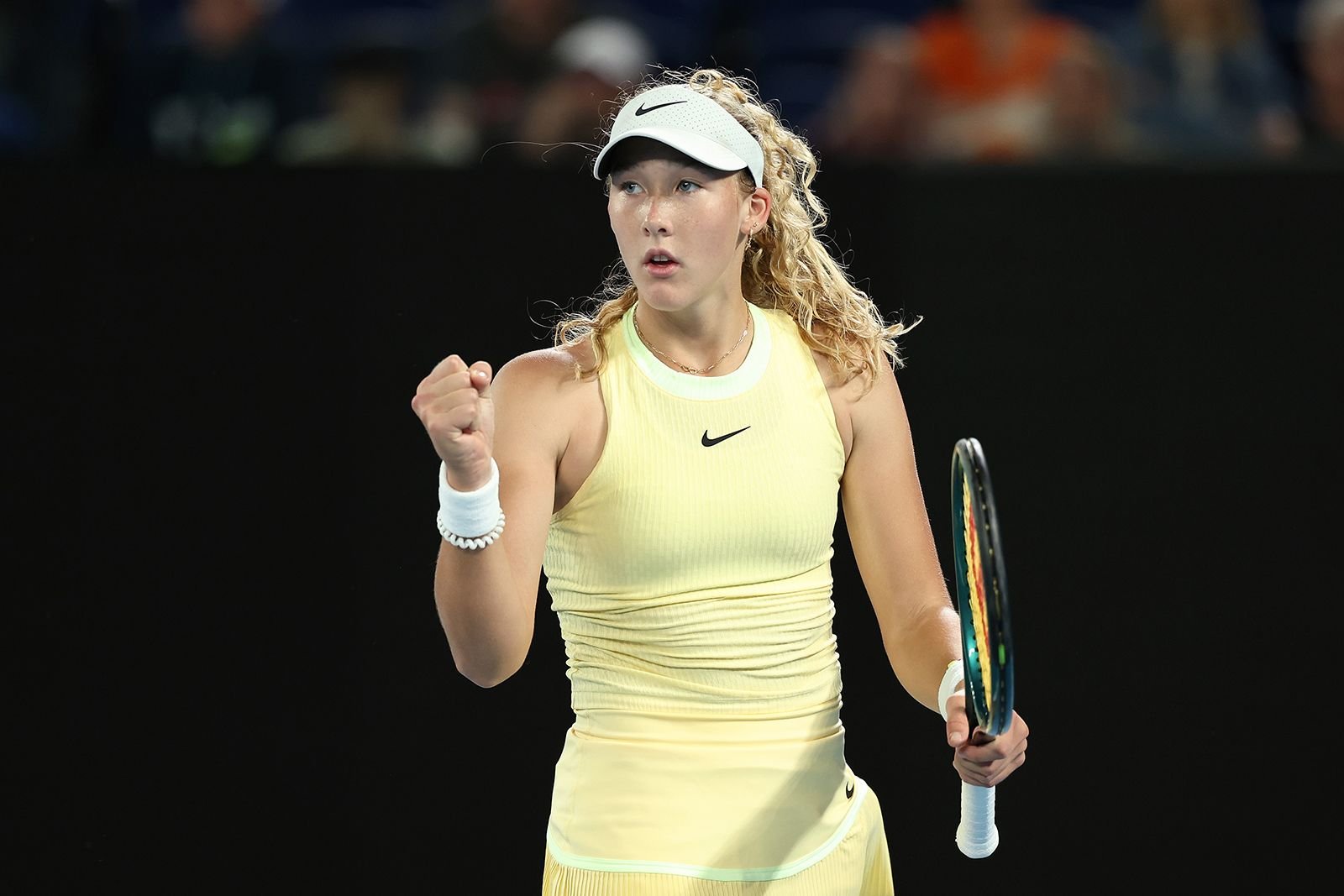
Tennis fans around the world are currently buzzing about one name: Mirra Andreeva. If you have been following the 2026 French Open, you know exactly why. This young Russian athlete is not just participating in Grand Slams; she is dominating them. While her powerful groundstrokes and mental toughness steal the spotlight, the statistic that leaves everyone speechless is her birth certificate. When we talk about the Mirra Andreeva age debate—if there even is one—the numbers are staggering because she is achieving feats that most players only dream of in their late twenties.
Born on April 29, 2007, Mirra Andreeva is currently nineteen years old as she competes on the biggest stages in tennis. In an era where the physicality of the sport demands peak athleticism, seeing someone so young dismantle seasoned veterans is a sight to behold. Unlike the “next big thing” labels that often fizzle out under pressure, Andreeva seems to be made of different material. She doesn’t look like a teenager when she is on the court; she looks like a general commanding a battlefield.
Understanding the Mirra Andreeva age factor is key to appreciating the magnitude of her success. To be nineteen in professional sports is to be at an age where experience usually trumps youthful exuberance. Yet, Andreeva has flipped that script entirely. She isn’t just the future of women’s tennis; she is the present. This article dives deep into her journey, her historic milestones, and how her youth is her greatest weapon in a sport known for its mental warfare.
The Rising Star: Who is Mirra Andreeva?
So, who exactly is this girl taking the tennis world by storm? Mirra Andreeva hails from Krasnoyarsk, Siberia, a region not traditionally known as a hotbed for tennis talent, though she later moved to Moscow to hone her skills. From a very young age, it was clear that she was different. While other kids were playing for fun, Andreeva was playing to win. Her older sister, Erika Andreeva, is also a professional player, creating a sibling rivalry that pushed both of them to higher levels.
It is easy to get lost in the statistics, but the most compelling aspect of her story is her rise through the ranks. When you consider Mirra Andreeva age when she turned professional, you realize she was barely a teenager. She made her WTA main draw debut at just fifteen years old in 2022. That is high school age. While her peers were worried about exams, Andreeva was trading baseline rallies with the best athletes on the planet. That kind of leap requires not just physical talent but an immense level of psychological readiness.
Her breakthrough moment came in 2023 when she made a stunning run at Wimbledon. At sixteen, she came through the qualifying rounds and bulldozed her way to the fourth round. The tennis world stopped and stared. Here was a kid who wasn’t afraid of the big stage. She didn’t look nervous. She looked like she belonged there. That tournament served as a global coming-out party, introducing fans to a player who would soon become a household name. The narrative surrounding Mirra Andreeva quickly shifted from “potential future star” to “current contender.”
Career Timeline and Early Achievements
To truly understand the genius of Mirra Andreeva, you need to look at the timeline of her victories. It is a compressed highlight reel that most players take a decade to compile. Let’s rewind to 2023. At just sixteen years old, she was named the WTA Newcomer of the Year. That award wasn’t just a participation trophy; it was a warning shot. She had arrived, and she wasn’t planning on leaving.
The following year, 2024, was a massive leap forward. At the Australian Open, she showed consistency, but it was the clay season that changed everything. At the 2024 French Open, aged just seventeen, she stormed into the semi-finals. To put that in perspective, she became the youngest player to reach a Grand Slam semi-final since the legendary Martina Hingis in 1997. That is not just good; that is historic. She backed this up by winning a silver medal at the Paris Olympics in doubles, proving her versatility.
But 2025 was the year of the crown. Still a teenager, Andreeva captured her first WTA 1000 titles. She won in Dubai and then followed it up immediately by conquering Indian Wells. The Indian Wells final was a masterclass in resilience. Facing the hard-hitting Aryna Sabalenka, Andreeva lost the first set but never lost her belief. She turned the match around in front of a stunned crowd. When we talk about Mirra Andreeva age during this run, she was only seventeen years old, beating the number one player in the world in a desert shootout.
The numbers don’t lie. She recorded her 100th career win in March of 2026 at Indian Wells. At 18 years, 10 months, and 7 days old, she became the youngest woman to hit that century mark since Coco Gauff. Just a few weeks later, she recorded her 50th WTA 1000 win. This statistical dominance proves that she isn’t just surviving at this level; she is thriving.
Physical Attributes and Playing Style
What makes a nineteen-year-old capable of overpowering women ten years her senior? It is a combination of physical genetics and technical polish. Standing at 5 feet 9 inches (1.75 meters), Andreeva has the perfect frame for modern tennis. She isn’t the tallest player on tour, which allows her to have elite-level movement, but she is tall enough to generate significant leverage on her serve and groundstrokes.
Watching Andreeva play is like watching a chess grandmaster who also happens to be a sprinter. Her game is built on exceptional tactical intelligence. She doesn’t just hit the ball hard; she constructs points with patience that is rare for someone of her age. She has a remarkable ability to read the opponent’s serve and return with interest. Coaches often note that her decision-making is her superpower. While other teenagers might panic and go for a low-percentage winner, Andreeva often chooses the high-percentage shot that keeps the pressure on.
Another astonishing trait for a player her age is her emotional control. We have seen prodigies before who crumbled under the weight of their own emotions. But Mirra Andreeva has a poker face that would make a Las Vegas dealer jealous. Even when she is down a break point, she rarely shows frustration. This mental steeliness, combined with a very athletic build, allows her to extend rallies and wait for her opponent to blink. As she grows physically stronger in her twenties, the power game will only get more intimidating.
The 2026 French Open Breakthrough
We cannot discuss the trajectory of this star without dedicating significant time to the 2026 French Open. This is where the legend is currently being written. Entering Roland Garros, the expectations were high, but the reality has exceeded them. Andreeva has turned the clay courts of Paris into her personal playground, dismantling opponent after opponent with a ferocity that is shocking for the field.
The run to the final has been filled with statements. In the quarter-finals, she faced veteran Sorana Cirstea. The age gap between Andreeva and Cirstea is seventeen years, marking one of the largest age differences in a Grand Slam quarter-final in the modern era. Did the age gap matter? Not at all. Andreeva destroyed the veteran 6-0, 6-3 in just 56 minutes. That “double bagel” threat in the first set was a loud message: the future is here.Mirra Andreeva Age
Then came the semi-final. Standing across the net was Marta Kostyuk, the player who had beaten her in the Madrid final just weeks prior and boasted a 17-match winning streak on clay. This was the ultimate test of the Mirra Andreeva age narrative. Could a teenager overcome a recent loss against an in-form opponent on a massive stage? The answer was a resounding yes. Andreeva won 6-1, 6-3, advancing to her first Grand Slam final without dropping a set. She became the third-youngest finalist in Paris in the 21st century, trailing only Coco Gauff and Kim Clijsters. It is a performance for the ages.
Family and Coaching Support System
No star rises alone, and Mirra Andreeva is no exception. Her support system is tight-knit and strategically brilliant. Coming from a family where tennis is the primary language, her parents, Alexander and Raisa, have been instrumental in her development. Her mother, Raisa, introduced her to tennis after falling in love with the sport watching Marat Safin, and the family relocated multiple times to ensure Mirra and Erika had the best training facilities.
A pivotal figure in her recent success is her coach, Conchita Martinez. Martinez is a Wimbledon champion and a former world number two. Having a legend in your corner is invaluable for any player, but especially for a teenager. Martinez provides the calm, experienced head that guides Andreeva through the storms of a tennis match. The partnership seems seamless; Martinez understands the mental toll of the tour because she has lived it.
There is also a charming, human side to the financial reality of her age. Because of her age, for a long time, Mirra Andreeva couldn’t even access her prize money. In interviews after winning massive checks, she famously admitted that all the money went to her dad’s credit card because she wasn’t eighteen yet and couldn’t open her own bank account. It is a funny, grounding detail that reminds us that despite the warrior on the court, off the court, she is still navigating the administrative hurdles of being a teenager.
WTA Ranking and Current Season Stats
As of the 2026 French Open, the rankings reflect the changing of the guard. Mirra Andreeva entered the tournament as the World No. 8. However, with her deep run in Paris, she is projected to crack the Top 5 for the first time in her career. This isn’t a fluke ranking; it is the result of consistent heavy lifting over the last eighteen months. She has amassed over 4,500 points, closing the gap on the veterans ahead of her.
Her statistics for the 2026 season are mind-boggling. Before the French Open final, she had already secured over thirty wins on the season. Specifically, on clay, she has been nearly unbeatable. Winning titles in Linz, making the final in Madrid, and now the final in Paris shows an incredible level of durability. Clay is the most physically demanding surface, requiring long rallies and tough sliding. For a player with her slight frame, the fact that she is outlasting power hitters on this surface speaks volumes about her fitness and endurance.Mirra Andreeva Age
When you filter the stats by “Big Titles,” the disparity between her and her peers becomes clear. She has already won two WTA 1000 events. Many players go their entire careers without winning one. The fact that she has two, plus an Olympic silver medal, before her twentieth birthday puts her on a trajectory that is currently only comparable to the all-time greats.
| Statistic | Detail |
|---|---|
| Current Age | 19 years old (Born April 29, 2007) |
| Height | 5 ft. 9 in. (1.75 m) |
| Current WTA Rank | World No. 8 (Career High Top 5 projected post-French Open) |
| Career Wins | 100+ (Reached March 2026) |
| Grand Slam Best | Finalist (2026 French Open) |
| Notable Titles | 2x WTA 1000 Champion (Dubai, Indian Wells) |
Comparisons with Other Tennis Prodigies
We must be careful when throwing around comparisons to legends, but it is impossible not to look at Mirra Andreeva and think of the greats. The most immediate comparison is with Coco Gauff. Like Gauff, Andreeva burst onto the scene as a teenage qualifier at Wimbledon. However, Andreeva’s rise to the top 10 has been even more aggressive in terms of results against top-10 opponents.
Then there is the comparison to Emma Raducanu. While Raducanu famously won the US Open as a qualifier, she struggled with consistency afterward. Andreeva has shown the opposite trait: consistency. She doesn’t just have one good tournament; she has deep runs at almost every event she enters. As noted earlier, Andreeva has already earned more career prize money than Raducanu, despite Raducanu being a Grand Slam champion for years, simply because Andreeva plays so many matches deep into every week.
tFinally, the statistical comparison to Maria Sharapova is inevitable, given they are both young, blonde, Russian powerhouses. However, the Mirra Andreeva age comparison to Sharapova is interesting. Sharapova won Wimbledon at seventeen. Andreeva is nineteen and reaching her first final, slightly later, but her game style is different. Sharapova was all aggression; Andreeva is a counter-puncher with aggression. She might be the evolution of the Russian tennis school—more athletic, more tactical.
Future Outlook and Potential
So, what does the future hold for Mirra Andreeva? If she continues on this trajectory, the sky is truly the limit. Right now, she is knocking on the door of the number one ranking. The current top players like Aryna Sabalenka and Iga Swiatek are in their prime, but Andreeva has the head-to-head wins to suggest she is not afraid of them. She has beaten Swiatek before, and she figured out Sabalenka at Indian Wells.
The physical maturation that will happen over the next five years is a terrifying thought for the rest of the WTA Tour. As she ages from nineteen to twenty-four, she will naturally add more muscle mass and power to her serve. Currently, her serve is a weapon, but it can become a missile launcher. If she adds five to ten miles per hour on her first serve while maintaining her current return stats, she will become almost unbreakable.
Moreover, her mental game will only sharpen. Every loss she suffers now is a lesson learned. She has already shown the ability to adjust tactics between matches, like her revenge win against Kostyuk in the semi-final. If she wins her first Grand Slam at the 2026 French Open, the floodgates will likely open. Pressure will turn into expectation, and given her personality—she once joked that the crowd cheering for her opponent sounded like they were cheering for her—she seems uniquely equipped to handle that spotlight.
Conclusion
In the grand tapestry of sports, we occasionally witness a talent so pure, so refined, that we feel lucky to watch it unfold in real-time. Mirra Andreeva is that talent. The conversation about the Mirra Andreeva age will eventually become irrelevant because she will simply be known as the best, not the “best young” player. But for now, her age is the headline because it defies logic. Nineteen-year-olds aren’t supposed to be this complete, this poised, or this dominant.
From the freezing courts of Siberia to the red clay of Paris, her journey is a testament to hard work, family sacrifice, and an unshakable belief in her own abilities. She has demolished records held by legends, outlasted seasoned professionals, and handled the financial and emotional realities of being a teenager in a billion-dollar industry with grace and humor.
As she stands on the precipice of her first Grand Slam title, one thing is clear: the future of women’s tennis is in very safe, very talented hands. The teenage phenom is no longer a promise; she is the present reality. Watch closely, because if you blink, you might miss her rewriting the history books again.
Frequently Asked Questions (FAQ)
How does Mirra Andreeva age compare to other top WTA players?
Mirra Andreeva age is significantly younger than the average WTA top 10 player. At 19, she is often facing opponents who are in their mid-to-late twenties or even thirties. For instance, during the 2026 French Open, she faced Sorana Cirstea, who is 36 years old, making Mirra Andreeva age gap nearly two decades younger than her opponent. This makes her achievements against such experienced players even more impressive.
What is Mirra Andreeva’s exact date of birth and star sign?
Mirra Andreeva was born on April 29, 2007. This makes her a Taurus. Taurus individuals are often known for their stubbornness, determination, and reliability—traits that are clearly visible in their never-say-die attitude on the tennis court. Knowing the specific Mirra Andreeva age and birthdate allows fans to track exactly how young she was when she achieved specific milestones, such as winning her first WTA 1000 title at seventeen.
How did Mirra Andreeva celebrate turning 19 in 2026?
While specific celebration details are kept private, Mirra Andreeva turned 19 just weeks before the 2026 Rome Open. Rather than taking a vacation, she celebrated by competing and winning. Shortly after turning 19, she secured her 50th career win at the WTA 1000 level. It appears her idea of a birthday gift to herself was breaking more records, proving that the Mirra Andreeva age milestone didn’t slow her down one bit.
Why is Mirra Andreeva’s age a big deal in tennis discussions?
The Mirra Andreeva age is a big deal because of the “Crossover Effect.” In professional tennis, players usually peak in their mid-to-late twenties. Andreeva is competing at a top-8 level while being physically immature compared to her rivals. She hasn’t even reached her physical peak yet. The implication is terrifying for the competition: if she is this good at 19, what will she look like at 24? It suggests she has a decade of dominance ahead of her.
Has Mirra Andreeva’s age ever been a barrier in her career?
Surprisingly, the most significant barrier regarding Mirra Andreeva’s age has been financial, not athletic. For a significant portion of her career, she was unable to access her prize money because she was a minor. She famously noted that her winnings went straight to her father’s credit card because she was not old enough to have her own bank account. Legally, her Mirra Andreeva age restricted her financial independence, even as she was earning millions on the court.
Who is the coach for Mirra Andreeva?
Mirra Andreeva is currently coached by former Wimbledon champion Conchita Martinez. Martinez was brought in to provide tactical maturity and guidance. Given the rise in Mirra Andreeva’s performance since their partnership began, specifically regarding her defensive skills and variety on clay, the pairing has been a massive success.
Does Mirra Andreeva have a sister who plays tennis?
Yes, Mirra Andreeva has an older sister, Erika Andreeva, who is also a professional tennis player. The two have faced each other on the WTA tour, notably at the 2024 Wuhan Open, where the older sister, Erika, won the match. Their family dynamic is unique in the tennis world, as both siblings push each other to improve while traveling the circuit.
What is Mirra Andreeva’s highest ranking so far?
As of the 2026 French Open, Mirra Andreeva is ranked World No. 8, but with her performance reaching the finals, she is projected to break into the top 5 (specifically projected No. 4 or 5) once the tournament concludes. This will be the highest ranking of her young career, setting a new personal benchmark for the rising star.